
Accounting,Business,Business Consultant,Corporations,Education,Government,In the news,Management Accounting,Small Business
Reading the Warning Signs: What Financial Risk Means for Long-Term Business Health
In the News — A recent shift by Moody’s Investors Service has placed Washington on a negative outlook, raising concerns about the State’s long-term financial trajectory. While Washington remains among a small group of states holding a coveted AAA credit rating, this change signals increased risk. If that rating were to decline, the ripple effects would be significant—higher borrowing costs, reduced access to capital, and delays or cancellations of major infrastructure projects that rely heavily on financing.
From a financial and forensic accounting perspective, this situation offers a clear and practical lesson for business owners. The same principles that impact a state’s creditworthiness apply directly to the financial health and sustainability of any organization, regardless of size.
At its core, a negative outlook is not about a single event—it reflects a pattern of financial behavior over time. It highlights the importance of understanding how income, debt, spending, and reserves work together to either strengthen or weaken long-term stability.
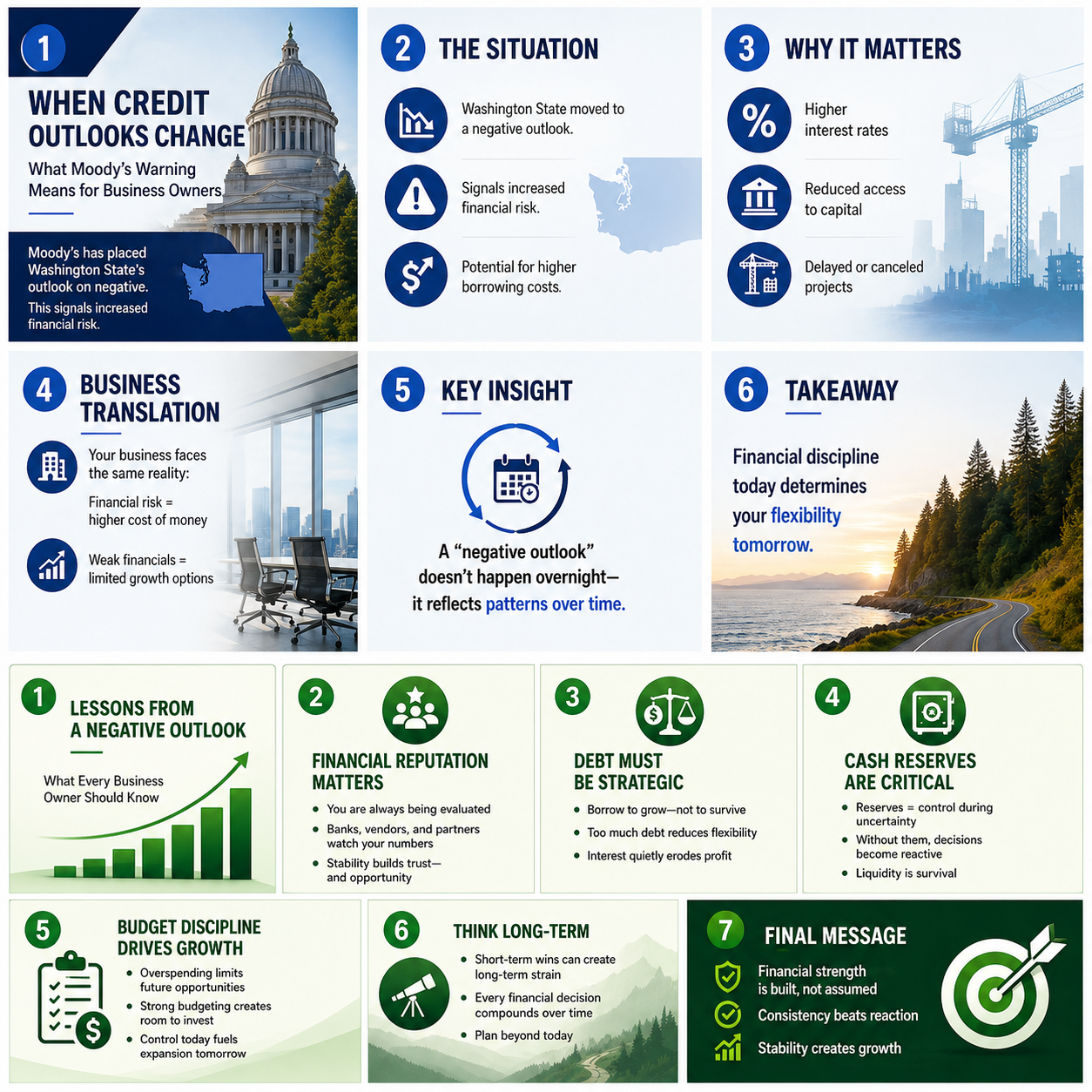
For business owners, the parallels are direct:
- Financial reputation matters more than you think—lenders, vendors, and partners are always assessing your stability, even if there’s no formal “rating” attached
- Debt should be strategic, not habitual—borrowing to grow is different than borrowing to survive
- Cash reserves are critical—they provide flexibility and control when revenue slows or unexpected costs arise
- Budget discipline drives opportunity—poor financial management today limits your ability to invest and grow tomorrow
- Long-term planning outweighs short-term gains—today’s decisions will define your future financial position, for better or worse
The takeaway is simple but powerful: financial stability is built through consistent, disciplined decision-making over time. Whether at the state level or within a small business, exceeding income, underestimating debt, and failing to plan for the future will eventually surface—and when it does, the cost is often far greater than anticipated.
This moment serves as a reminder that growth and solvency are not achieved through optimism alone, but through a clear understanding of financial realities and the discipline to act accordingly.
Pivotal Forensic Accounting & Audits is available to help you evaluate your financial outlook and health.
📞 Phone: (253) 752-3920
📧 Email: contactus@pivotalaccountant.com